March 19, 2019
I did not know then when I set out for Denver that Sunday, whether I would return to an empty bed. The awesome beauty of the Rocky Mountains was tempered by the crushing suspense. “Quality-of-life” care can be an unknown beast with a long tail.
“Your dog is funny looking,” is all the nameless woman said, glancing across the street, while towing an empty wire cart with one loping wheel. What could I say? She was right.
You don’t set out for the local rescue shelter with your wife and two squealing daughters and the idea that you’ll take a look, leave to think things over, and then come back another day. No, you go in boldly, knowing it’s literally a crap “chute.” I consider myself lucky that all three converged on the same bundle – small, black mostly with one white paw, ending not too far back in a corkscrew tail.
With papers signed and promises made, we took Rascal home.
We suspected abuse. Simple things caused him to flinch or recoil outright. The broom. An open hand. The cardboard core from an empty roll of paper towels. We all tried our best to undo the hurt, to blot out the stains of earlier cruelties.
There are things I would have done differently and will next time with the next one, if there is a next time and a next one. I would have been more careful the first time I trimmed his nails. I would not have nipped his quick and set us up for a lifetime of professional nail care. I’m not sure when they started writing the word “CAUTION!” on his intake papers, highlighting it in yellow for the emphasis the large block letters and exclamation point didn’t adequately convey. That one was my fault. I would have fixed the fence sooner. I would have trained him to heel on walks to the duck pond. I would have taken him on walks to the duck pond. I would have trained him to ignore the cats. I would have trained him to know that there would always be enough food. I would have trained him to take fluids from a syringe for the time when food would not be enough. I would have trained him.
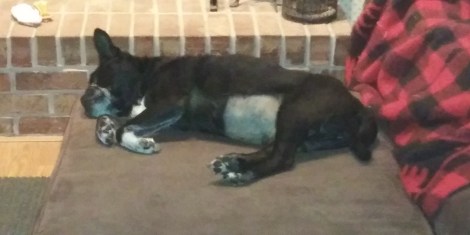
Rascal was my office mate for the last seven years. We spent the better part of each workday on opposite sides of my computer monitors, rarely in direct sight of each other. It didn’t take long for our schedules to synchronize. We shared a daily tickler file of regimented inputs and outputs – more like a “tinkler” file, you might say. I’ve joked before that we became so close we would finish each other’s “scentences.”
By this time, “Rascal” had given way to “Manny” or “Squally.” I usually just called him “buddy” – small “b.”
A sprinkling of salt around his muzzle and eyes had long ago signaled his advancing age – something I see in the mirror every morning. And then last August his back end showed weakness and tremors. He took on the stance of a shepherd but with his ankles braced, one against the other, to keep his haunches from sinking even lower.
I searched the web and watched for more signs.
And I obsessed over his breathing. You could plot the movement – in and out – as vectors, up and down, the arrow of time always and forever moving to the right, and arrive at something close to a perfect sinusoidal wave. But if you look more closely at the point when down should change to up, you’ll see the perfect wave bottom out – flatline – for a moment. And if that’s the moment when you sit up and look over your monitors, you’ll find that your own breath has stalled. You resist the impulse to inhale until you can, in sympathy, take air back in and breathe again.
One month ended. And then another. Week after week, he defied expectations. Down the ramp and then back up again after his sentry rounds past the brush pile, the shed, and the garden. Long naps filled the time in between. Each morning I wiped the kitchen floor and spiked his water.
Through all of this, he showed me just how tenacious life can be. And then, in turn, life showed me how naïve it can be to wish for more.
With him, wishing did not turn his gaze from the empty walls and empty corners or bring his stubby salty face back into the cradle of my cupped hands when I called.
Wishing did not make him hungry again or stop the tremors or restore the flesh to his shoulders, ribs, and spine.
Wishing did not hasten the sleep for which his body was slowly preparing.
I wondered some days, while Gloria was at work, whether it would be a deniable act of love or mercy to lay down beside him, embrace him, and squeeze him tightly…then tighter…and tighter.
One truth is that he was not my first choice. Another truth is that I did not want him at all. The best truth is that there was no better choice. The difference was never out there in the particular bundle of fur, teeth, and tail but in my capacity to care and to love regardless of whose searching eyes were anxiously looking back at me and my unknown face and unknown hands – even if those eyes were so big and so round that his peripheral vision, left and right, touched somewhere behind his ears.
But I can be defiant too. I spent my last wishes. First, that he would pass at home. He did. Second, that he would pass peacefully. He did. And third, that Gloria and I would be with him. We were.
I buried him the next morning, on Valentine’s Day, wrapped in his fleecy red and black moose blanket in a spot behind the shed that he seemed to favor on his sentry marches. He would often stop there, look back at the house, pause, and then disappear around the back to do who knows what. Elly called it his “nichtsnutz” corner. The icy ground yielded easily to my shovel between the oak and arborvitae that will now stand watch. “Be a good boy,” I breathed out before I picked up his bed cushion and my tools and went inside.
The boundary of whatever it is that makes up my “self” encircled him in my moment-to-moment awareness long ago. As I now do any one of a thousand things, I still feel the shock of surprise, still expecting that nothing has changed.
No rush.
The forgetting will come soon enough.
 Thinking in Circles